
What is a TAPA certificate?
A TAPA certificate is one of the most widely recognized security standards in the global supply chain. The name comes from TAPA (Transported Asset Protection Association), an international organization founded in 1997 that brings together manufacturers, carriers, logistics operators, and insurance companies from around the world. The organization’s goal is to reduce losses resulting from theft and damage to high-value cargo and to strengthen the resilience of the entire supply chain in road transport and warehousing.
What is TAPA in practice? It is a set of rigorous, voluntary standards that precisely define the physical security measures, operational procedures, and staff training a transport or logistics company must implement to obtain certification at a given level. A TAPA certificate is not a legal requirement, but in practice it is increasingly becoming a condition for entering into commercial contracts - especially in industries dealing with high-value goods such as electronics, pharmaceuticals, or luxury items.
At Zet Transport, we fully understand how important this trust is. As a certified carrier, we hold TAPA TSR 1 and TAPA TSR 3 certifications, which allow us to carry out high-value cargo transport in compliance with the highest security standards in the industry.
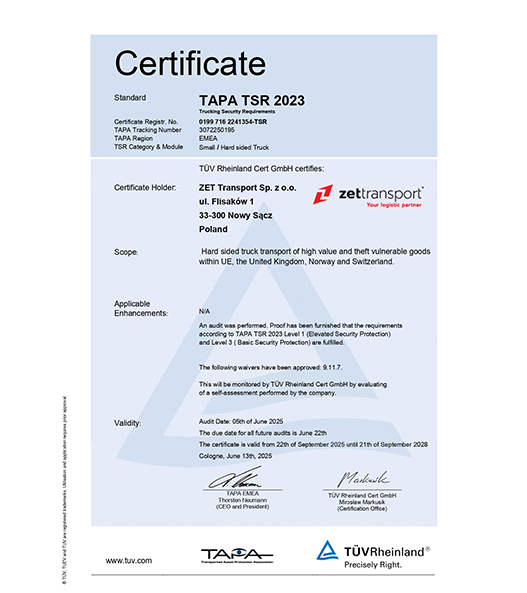
TAPA Certificate – the highest level of security
Zet Transport holds the TAPA 1 (Trucking Security Requirements) certificate – the highest level of protection in road transport.
This means that our vehicles, drivers and logistics processes meet rigorous standards regarding the protection of high-value cargo.
GPS systems, geofencing, monitored vehicle access and continuous driver training guarantee maximum shipment security.
Why is cargo security so important today?
Global supply chains are becoming increasingly complex, while at the same time more exposed to risk. Cargo theft during road transport, downtime at unsecured parking areas, or unauthorized access to warehouses generate real financial losses - not only for the carrier, but also for the manufacturer, the shipper, and ultimately the end customer. The growing value of transported goods, increasingly specialized criminal groups, and time pressure within supply chains mean that standard security measures are no longer sufficient.
This is precisely why banks, insurance companies, and large shippers are increasingly requiring their logistics partners to hold TAPA certification as a condition of cooperation. A TAPA certificate signals to the market that a company applies risk analysis, modern monitoring technologies, and strict security procedures at every stage of transport.
Who should hold a TAPA certificate?
TAPA certification is particularly relevant for:
-
Transport companies and road carriers handling high-value goods or cargo exposed to an increased risk of theft.
-
Warehouse operators and logistics centers storing goods in transit.
-
Owners and operators of truck parking facilities where vehicles stop during long-haul routes.
-
Manufacturers and shippers of high-tech goods, pharmaceuticals, electronics, cosmetics, or luxury products who require a defined level of security from their subcontractors.
At Zet Transport, we carry out exactly this type of work - transporting high-value goods in accordance with TAPA TSR 1 and TAPA TSR 3 certifications, serving clients for whom cargo security is a top priority.
What types of goods are most often transported under TAPA standards?
TAPA standards were originally developed for the high-tech sector, but today they cover a much broader range of goods. The most commonly transported under TAPA requirements include:
-
Electronics and IT equipment (laptops, smartphones, components).
-
Pharmaceuticals and medical products.
-
Jewelry and luxury items.
-
Premium cosmetics and luxury goods.
-
Branded clothing and footwear.
-
High-value automotive parts.
-
Home appliances and electronic accessories.
These are goods that are both attractive to criminals and easy to resell quickly, which is why they require enhanced protection at every stage of transport.
What standards are covered by TAPA certification?
The TAPA certification system is not a single document but a family of complementary standards that together cover the entire supply chain - from the warehouse, through transport routes, to parking locations.
TAPA FSR (Facility Security Requirements)
TAPA FSR is a standard dedicated to logistics facilities and warehouses, including storage locations for goods in transit. It covers requirements related to perimeter and building security, access control to warehouse and office areas, CCTV monitoring systems, incident response procedures, staff training, and in the latest versions - cybersecurity. FSR certification is assigned to a specific location rather than an entire company, meaning each facility must undergo an independent audit.
TAPA TSR (Trucking Security Requirements)
TAPA TSR focuses on road transport and is key for carriers such as Zet Transport. The standard includes security and responsibility management, driver training, real-time vehicle and route monitoring, incident response procedures, and specific physical and technological vehicle protections. At Zet Transport, we have implemented, among others, SBS mechanical locks, remotely controlled electronic locks, independent systems detecting unauthorized door opening in both the cab and trailer, panic buttons, and geofencing with instant alerts if a vehicle deviates from its route.
TAPA PSR (Parking Security Requirements)
TAPA PSR addresses one of the biggest risks in road transport - cargo theft during vehicle stops. The standard includes securing parking areas and entry/exit points, monitoring, lighting, safety procedures, and often the presence of security personnel. At Zet Transport, we apply a strict procedure for designating secure parking locations for every high-value transport.
Differences between FSR, TSR, and PSR
The main difference between these three standards lies in their scope: FSR protects stationary facilities (warehouses, distribution centers), TSR protects movement - vehicles, drivers, and routes - and PSR protects vehicles when they are stationary, i.e., parked. A company operating across the full supply chain may require all three certifications, while a road carrier such as Zet Transport focuses primarily on TSR, supplemented by the use of PSR-certified parking along the route.
TAPA certification levels – what are the differences?
Each TAPA standard is divided into several security levels - the higher the level, the stricter the requirements and the higher the implementation cost, but also the greater the level of cargo protection.
FSR levels - A, B, and C
-
Level A: The highest level of physical, procedural, and technological protection, required primarily for facilities in high-risk countries or handling the most valuable goods.
-
Level B: A medium level of security, suitable for facilities with moderate risk, still requiring alarm systems and regular staff training.
-
Level C: A basic, cost-effective level of protection, possible to obtain through self-certification.
TSR levels - 1, 2, and 3
-
TSR 1: The highest level of security, designed for very high-value goods. It requires, among others, GPS systems reporting vehicle location even every 5 minutes, hidden tracking devices, electronic locks, door and trailer opening sensors, specialized driver training, and for the most sensitive transports - even escort services. This is the level held by Zet Transport.
-
TSR 2: An intermediate level, suitable for medium-value goods (e.g., clothing, household appliances), with GPS monitoring reporting every 15–30 minutes and basic anti-theft protections.
-
TSR 3: A basic, minimum acceptable level of security, allowing self-certification without a full external audit. \
Zet Transport also holds the TAPA TSR 3 certificate, enabling flexible adjustment of security levels to the value and risk of a given cargo.
How to choose the right level of security?
The choice of certification level primarily depends on the value of the goods and their susceptibility to theft, the requirements set by the client or their insurer, and the geographical risk along the route. The shipper (buyer) always defines the required TSR level and communicates it to the carrier. Thanks to holding both TSR 1 and TSR 3 certificates, Zet Transport can offer solutions precisely tailored to client needs - from the highest level of protection to standard high-value cargo transport.
What requirements must be met to obtain TAPA certification?
To obtain TAPA certification at a given level, a company must implement and document compliance in several key areas:
-
Security management and accountability, including appointing responsible persons for security policy.
-
Risk analysis, meaning regular and documented assessment of threats for specific routes and locations.
-
Physical and technical safeguards, such as appropriate locks, seals, alarm systems, and GPS monitoring.
-
Operational procedures, including detailed instructions for standard and emergency situations.
-
Staff training for drivers, dispatchers, and management in line with the applicable standard.
-
Incident response procedures, ensuring clear communication and escalation paths in case of security events.
Companies applying for TSR Level 1 or 2 must also have a minimum fleet of vehicles registered in the TAPA system. In practice, this means several vehicles per certification, although smaller carriers may include subcontractor vehicles in the audit; however, full responsibility for compliance remains with the certified entity.
What does the TAPA certification process look like?
The TAPA TSR certification process typically includes several stages:
1. Initial audit (readiness assessment): defining the target TSR level, number of vehicles, and reviewing current safeguards with gap analysis.
2. Implementation: upgrading physical and technical security measures and developing procedural documentation.
3. Training: training drivers, dispatchers, and monitoring staff; at least one company representative must complete official TAPA training and pass an exam.
4. Testing and internal audit: verifying alarm systems and response procedures before the external audit.
5. Certification audit: conducted by an independent TAPA-accredited auditor, including on-site verification and vehicle inspections.
6. Certification issuance: after a successful audit and closing any non-conformities, the certificate is issued for 3 years, with mandatory annual self-assessments in years two and three.
How long does implementation take?
The timeline depends on the certification level, fleet size, and current security standards within the company. In practice, the entire process - from initial audit through implementation, training, and final certification - typically takes from a few to several months. Implementing TSR 1 usually takes longer due to advanced technical requirements (e.g., electronic locks, tracking systems, escort procedures), while TSR 3 can often be achieved faster, sometimes via self-certification. After certification, the company must maintain compliance throughout the 3-year validity period.
How much does TAPA certification cost?
The cost of TAPA TSR certification in Poland varies depending on the certification level, fleet size, and service provider. Indicative market rates for full TSR 1 implementation (including initial audit, procedures, training, and final audit) range from several thousand to over twenty thousand PLN net, depending on the scope of consulting services. Basic consulting support may start from around PLN 4,000, but final pricing is always tailored individually.
Additional costs include TAPA registration fees and the certification audit conducted by an accredited body; these fees may be waived for TAPA members paying membership dues. It is worth noting that this is an investment spread over the 3-year validity period and across multiple high-value transport operations.
What are the benefits of TAPA certification?
TAPA certification offers tangible business advantages:
-
Credibility with clients, demonstrating compliance with top international security standards.
-
Access to new contracts, as many large shippers require TAPA certification.
-
Reduced losses thanks to structured procedures and lower theft risk.
-
Lower insurance costs for cargo policies.
-
Competitive advantage in tenders, where TAPA is often a formal requirement.
With TAPA TSR 1 and TSR 3 certifications, Zet Transport provides clients with a real guarantee of secure high-value cargo transport, supported by 24/7 monitoring, thorough staff verification, and specially trained drivers.
TAPA vs other standards
TAPA and ISO 9001
ISO 9001 is a quality management standard focused on processes, customer satisfaction, and continuous improvement within an organization. TAPA, on the other hand, focuses exclusively on physical security and protecting cargo from theft. These standards are complementary - ISO 9001 organizes a company’s management processes, while TAPA adds a layer of specific, measurable security requirements.
TAPA and ISO 28000
ISO 28000 is an international standard for security management systems in the supply chain - it is systemic and general in nature, similar to ISO 9001 but focused on security. In comparison, TAPA is much more detailed and prescriptive - it precisely defines specific technical measures (e.g., types of locks, GPS reporting frequency), focusing on preventing losses of high-value goods, whereas ISO 28000 provides a more flexible framework for managing security risks.
TAPA vs AEO
AEO (Authorised Economic Operator) is a customs status granted by the European Union’s customs authorities, confirming a company’s reliability in terms of security and/or customs simplifications, which translates, among other things, into fewer border inspections. TAPA is a private, industry-specific certification focused on protecting goods from theft, while AEO is an official status related to customs law. However, the two strongly complement each other - especially the AEOS (security) variant, which focuses on similar risk areas as TAPA.
Is it worth combining systems?
Yes, in practice, many transport and logistics companies combine TAPA certification with ISO 9001, ISO 28000, or AEO status. This combination allows them to simultaneously demonstrate process quality, systematic security management, and customs reliability, which significantly increases their attractiveness to large, demanding international clients.
Common implementation mistakes
Companies implementing TAPA certification most commonly make the following mistakes:
-
Choosing an excessively high certification level without a realistic analysis of customer needs, which generates unnecessary investment and operational costs.
-
Treating certification as a one-time project rather than an ongoing process – TAPA requires annual self-assessment audits and maintaining compliance throughout the entire 3-year validity period of the certificate.
-
Insufficient training of drivers and freight forwarders – it is people, not just technology, who are the key element of the security system.
-
Lack of documented risk analysis – TAPA requirements are based on regularly updated threat assessments, not a one-time report.
-
Neglecting procedures at the subcontractor level – if subcontractors are involved in transport, full responsibility for compliance with TAPA requirements remains with the certified entity.
Is TAPA certification mandatory?
The TAPA certification is not a legal requirement - it is a voluntary, industry-specific security standard. There are no regulations that oblige transport companies to obtain it. In practice, however, for many market segments - such as the transport of electronics, pharmaceuticals, and luxury goods - TAPA certification becomes a prerequisite for cooperation, as large shippers and their insurers simply will not entrust high-value cargo to a company without the appropriate certification.
When does TAPA become a competitive advantage?
TAPA certification translates into a real competitive advantage when a company seeks contracts with clients from high-risk sectors - such as electronics, pharmaceuticals, premium automotive, or luxury goods. In these industries, TAPA TSR certification is often a formal requirement to participate in tenders.
This competitive edge is even greater when a company - like Zet Transport - holds certifications at multiple levels simultaneously (TSR 1 and TSR 3), enabling it to flexibly handle both the most demanding and standard high-value cargo transport orders without the need to engage external subcontractors.
Summary
TAPA certification is כיום one of the most important security standards in the transport and logistics of high-value goods. It includes three complementary systems - FSR for facilities, TSR for road transport, and PSR for parking areas - each divided into several security levels, from basic to the most stringent. Although certification is not legally required, in practice it has become a gateway to entering the market for theft-sensitive cargo, delivering tangible business benefits such as increased credibility, access to new contracts, and reduced risk of loss.
Zet Transport holds TAPA TSR 1 and TAPA TSR 3 certifications, enabling us to carry out high-value cargo transport in line with the highest security standards - featuring route-specific risk analysis, 24/7 freight forwarder monitoring, thorough personnel verification, and advanced physical and technological vehicle security measures. If you are looking for a carrier that can ensure the safe transport of your most valuable goods, contact our team - we will help you select the appropriate level of protection tailored to your business needs.
Post author